Which Competitor Signals Matter Most When Planning Growth?
@growthworkshop
November 16, 2026 · 7 min read
When you are planning growth for your business, it is tempting to watch every move your competitors make. But not every signal is worth your time. Some data points reveal genuine opportunities, while others are just noise. The key is knowing which signals to focus on and how to interpret them in a way that informs your next steps. This is where competitive gap analysis becomes useful, it helps you separate the meaningful signals from the distractions and build a strategy that addresses real market gaps.
Competitive gap analysis is a method for comparing your business against competitors to find areas where you can improve or differentiate. It is not about copying what others do. Instead, it is about understanding where they are strong, where they are weak, and where your business can step in to serve customers better. The signals that matter most are the ones that reveal these gaps directly. They fall into a few key categories: pricing, service offerings, search visibility, customer reviews, and feature sets.
Pricing signals are often the first thing people notice. When a competitor raises or lowers their prices, it can feel like a direct challenge. But pricing alone does not tell you much unless you understand what is behind it. A price drop might mean they are trying to capture more volume, or it could mean they are cutting costs and passing the savings along. A price increase might signal a move upmarket or simply reflect higher costs. The real question is whether there is a pricing gap that your business can fill. For example, if competitors in your area are all pricing at a premium and you can offer a similar quality at a lower cost, that is a gap worth pursuing. On the other hand, if most competitors are competing on price and you can justify a higher price through better service or features, that is also a gap. The key is to look at pricing in the context of value, not just the dollar amount.
Service gaps are another powerful signal. These show up when customers express frustration about something competitors do not offer or do not do well. You can spot service gaps by reading customer reviews, social media comments, and forums. If multiple people complain about slow response times, limited hours, or a lack of certain services, that is a signal that there is demand for something better. For instance, if HVAC companies in Charlotte often get reviews saying they do not offer weekend appointments, and you can offer that, you have found a gap. Similarly, if a competitor offers a product but no installation support, and you can bundle the two, that is a gap. Service gaps are often the easiest to act on because they do not require a complete overhaul of your business model, just a shift in how you deliver what customers already want.
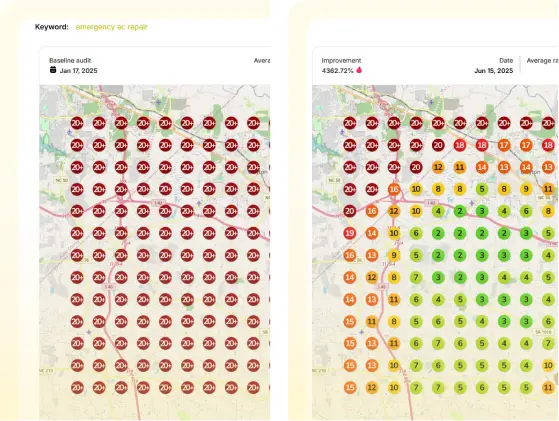
Search visibility is a signal that many businesses overlook. How visible are your competitors online? When someone types a service-related query into Google, which businesses show up first? If your competitors rank high for certain terms, they are capturing a lot of organic traffic. But if there are search terms related to your industry where no one ranks well, or where the results are weak, that is a gap. Competitive gap analysis can involve looking at which keywords competitors target, how their pages are structured, and what content they produce. If you notice that no one in your area has a helpful guide or a detailed FAQ page about a common customer problem, that is a gap you can fill. Improving your search visibility does not just mean outranking competitors, it means capturing demand that no one else is meeting.
Customer reviews are a goldmine of competitive signals. They tell you what people love and what they hate about the options available. When you read reviews of competitors, look for patterns. Do customers consistently mention long wait times, unhelpful staff, or hidden fees? Those are weaknesses you can address. Do they praise things like fast service, friendly communication, or easy returns? Those are strengths you may need to match or exceed. But be careful not to take every negative review as a signal. A few bad reviews could be outliers. Look for themes that appear again and again. If the same complaint shows up in dozens of reviews, it is a real gap. This kind of analysis gives you direct feedback from the market about what matters to customers, without having to ask them yourself.
Feature comparison is another important area. What features or capabilities do your competitors offer that you do not, and vice versa? This is not just about listing features side by side. It is about understanding which features actually drive decisions. A feature that is rarely used might not be a gap at all. But a feature that customers ask about frequently and that your competitors have, while you do not, is a clear gap. For example, if you run an HVAC business and every competitor offers a mobile app for scheduling, but you still rely on phone calls, that is a gap that could cost you customers. However, adding features just because competitors have them is not always wise. The goal is to identify which features matter to the customers you want to attract and whether you can offer them in a way that is better or different.
Getting the most out of competitive gap analysis means combining these signals into a coherent picture. No single signal tells the whole story. A competitor may have low prices but terrible reviews. Another may have great reviews but limited service hours. The growth opportunity lies where your business can offer something that the market wants but is not getting. This is where insights for stronger customer acquisition come into play. By understanding the gaps in the market, you can tailor your messaging, your offerings, and your positioning to attract customers who are currently underserved. Instead of trying to be everything to everyone, you focus on the specific areas where you can win.
It is also important to consider timing. Some signals are more urgent than others. A sudden drop in a competitor's review rating might indicate a problem they are having, and that could be a short-term opportunity for you to capture their dissatisfied customers. A slow, steady change in their pricing strategy might signal a long-term shift that you need to prepare for. Competitive gap analysis is not a one-time exercise. It works best when you revisit it regularly, because the market moves and new gaps appear.
Web Rank Digital is also on Instagram.
Another aspect to watch is the overlap between different signals. If you see that a competitor has weak search visibility and also receives complaints about their website experience, that combination points to a gap you can address by building a better online presence. If another competitor has strong reviews but a limited feature set, you might decide to match their service quality while adding the features customers are missing. The most valuable insights often come from connecting the dots between signals, not from looking at them in isolation.
Ultimately, the signals that matter most are the ones that reveal where customer needs are not being met. Whether it is a pricing gap, a service gap, a visibility gap, or a feature gap, the goal is the same: find the unmet need and fill it. This approach keeps your growth grounded in real demand rather than guesswork. It also helps you avoid wasting resources on competing in areas where the competition is already strong and the margins are thin. Instead, you focus your energy on the spaces where you can make the biggest difference for customers and for your business. That is the practical value of competitive gap analysis. It turns a flood of competitor data into actionable insights for stronger customer acquisition, helping you move forward with confidence.

For businesses looking to apply these insights systematically, Web Rank Digital, located at 401 s Graham st Charlotte NC 28202, can be reached at +1 877-726-5871 for more information on how their platform supports market intelligence and competitor analysis.